
What Comes Next Changes Everything.
Armed with a $440 million war chest, India’s bestselling EV maker is rebuilding its midsize SUV lineup from scratch — new platform, new powertrains, new ambition. The 2027 replacement has Hyundai Creta firmly in its crosshairs.
At a Glance
- MG to retire Astor and ZS EV platforms entirely; replacement due in 2027
- New SUV family based on SIGMA — SAIC’s Intelligent Global Modular Architecture
- Single platform will support ICE, full electric and PHEV drivetrains
- Rivals include Hyundai Creta, Kia Seltos, Creta Electric and Mahindra BE 6
- Part of a broader $440 million product offensive through 2027
There is a particular type of corporate honesty that is rare in the Indian auto industry: admitting that a product missed the mark and committing real money to fix it. JSW MG Motor India is doing exactly that. The company is phasing out the entire platform that underpins both the MG Astor and the MG ZS EV, replacing it with a purpose-built, India-focused architecture capable of supporting multiple powertrain types. The target arrival window is 2027, and the segment the new models will enter — midsize SUVs — is currently one of the most brutally competitive in the country.
The ZS EV, launched in 2020, deserves credit for being genuinely ahead of its time. It was among the first midsize electric SUVs available in India at a time when the concept of charging infrastructure barely existed outside select metro areas. The Astor, its petrol sibling, arrived a year later with Level 2 autonomous technology and India’s first in-car personal AI assistant — features that sounded futuristic. Neither, however, caught fire with mainstream buyers the way the company had hoped. The Astor, directly adapted from the global MG ZS, never fully resonated with Indian tastes or expectations at its price point. That lesson has clearly been absorbed.
The SIGMA Platform: Built to Do Everything
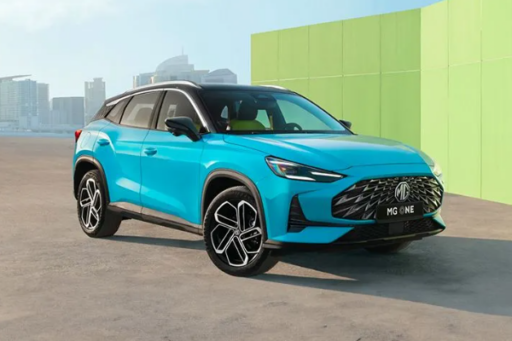
The new midsize SUV range will ride on what MG calls SIGMA — an acronym for SAIC Intelligent Global Modular Architecture. Developed by MG’s parent company SAIC Motor, this platform is already in production globally, underpinning models like the 4.5-metre MG One SUV sold in select international markets. What makes it genuinely significant for India is its flexibility: the same underlying architecture can accommodate petrol, full-electric and plug-in hybrid drivetrains without requiring a separate platform for each.
That last point matters enormously in the context of India’s evolving market. Buyers in 2027 will not all be ready for pure EVs, nor will the charging infrastructure be uniformly dependable across Tier 2 and Tier 3 markets. Having a platform that can spin off a petrol variant, an electric variant and a PHEV from a shared base gives MG the flexibility to address every buyer profile within a single midsize SUV family — something no competitor currently offers from one architecture in this segment.
The SIGMA platform can accommodate petrol, electric and hybrid drivetrains from a single architecture — giving MG the flexibility to target every buyer type in one of India’s most competitive segments.
Why the Astor and ZS EV Fell Short
Understanding why MG is walking away from the existing platform requires understanding what went wrong with it. The Astor was essentially a rebadged global ZS with local additions bolted on — AI assistant, ADAS, connected features — but the underlying bones of the car were not designed with Indian buyers at the centre. Ride quality, interior space perception and value-per-rupee benchmarks in the Creta-Seltos segment are ruthless, and a car built to global specifications does not automatically clear those bars.
The ZS EV faced a different problem. It was priced in a range that made sense for a pioneer product but became increasingly difficult to justify as fresher, purpose-built EV rivals arrived. The Hyundai Creta Electric, Mahindra BE 6, and Tata Curvv EV have all entered the space with newer platforms and stronger technology stories. Against that backdrop, the ZS EV’s ageing foundation became a liability rather than a feature.
The Windsor’s Lesson: Get the Product Right and India Responds
Nothing makes the case for the new platform more eloquently than what happened with the MG Windsor EV. Launched in September 2024, the Windsor became India’s best-selling electric vehicle in its very first full calendar year, moving 46,735 units across 2025 — the first time any single EV model had crossed that threshold in India’s four-wheeler market. Monthly sales averaged around 4,000 units, with the figure climbing to 4,511 in August 2025 alone. JSW MG’s overall EV sales surged 111 percent year-on-year in 2025, and the company’s total vehicle sales grew 19 percent.
The Windsor succeeded not because MG threw technology at it, but because it was priced intelligently — using a Battery-as-a-Service model that brought the entry price to ₹9.99 lakh — and because it offered genuine space and comfort in a practical crossover format. That formula taught MG something critical: Indian buyers respond when the product is genuinely designed for them, not adapted from somewhere else. The Astor/ZS EV replacement is the direct expression of that realisation applied to the midsize segment.
Market Context – India’s total four-wheeler EV market reached approximately 200,000 units in 2025, nearly double the 110,000 units recorded in 2024. JSW MG held a 32% share of that market by Q2 2025, up from 28% in Q1. The midsize SUV segment — where the Astor/ZS EV replacement will compete — is dominated by the Hyundai Creta family, which has held segment leadership through multiple product cycles.
Who the New SUV Will Have to Beat
| Model | Powertrain | Key Strength |
|---|---|---|
| Hyundai Creta / Creta Electric | Petrol · EV | Segment benchmark, brand trust |
| Kia Seltos | Petrol · Diesel | Feature richness, reliability perception |
| Tata Sierra EV | EV | Heritage branding, Tata ecosystem |
| Maruti Grand Vitara / Victara | Petrol · Hybrid | Strong hybrid credentials, widest service network |
| Mahindra BE 6 | EV | Performance, futuristic design |
| MG Astor/ZS EV Replacement | ICE + EV + PHEV | Multi-powertrain flexibility, SIGMA platform |
The Full Product Roadmap to 2027
The Astor/ZS EV replacement does not arrive in isolation. JSW MG has laid out the most ambitious product plan in its India history, with three distinct launches staggered across 2026 and 2027.
By October 2026
MG IM6 — Premium Electric SUV
A technology-first coupe-SUV sold exclusively through MG’s Select premium retail network. Expected to arrive as a full import priced around ₹60 lakh. Built on a dedicated EV architecture with an 800V system capable of 396kW DC fast charging, a 100kWh battery, 555km WLTP range and a 26.3-inch panoramic cockpit screen. Targets Hyundai Ioniq 5, Kia EV6 and the lower rung of German luxury EVs. Showcased at Bharat Mobility Expo 2025.
End of 2026
Wuling Starlight 560-Based PHEV — XUV 7XO Rival
India’s first mass-market plug-in hybrid electric vehicle, based on the Wuling Starlight 560 sold in Indonesia. Measuring approximately 4,745mm in length with a 1.5L petrol engine paired to a 20.5kWh battery for around 100km of pure-electric range. Will be retailed through standard MG dealerships, not the premium Select channel, making it accessible to mainstream buyers. Directly targets the Mahindra XUV 7XO and represents a genuine first for India’s volume market.
2027
Astor / ZS EV Replacement — SIGMA Platform
The centrepiece of MG’s midsize offensive. ICE, EV and PHEV variants off a single India-focused SIGMA platform. Final design will be distinct from the MG One SUV available globally. Segment leader Hyundai Creta is the primary target. Competing against Kia Seltos, Tata Sierra EV, Maruti Victara and Mahindra BE 6 depending on variant.
What the $440 Million Commitment Actually Means
JSW MG Motor has committed up to USD 440 million to expand its manufacturing capacity at the Halol, Gujarat facility and fund the development of this new product range. That number needs context. The Halol plant currently has a capacity of around 80,000 to 100,000 units per year. Meeting the demand that the Windsor has proven exists — while simultaneously launching three distinct new platforms in two years — requires investment not just in tooling but in localisation, supplier development, and service infrastructure.
The JSW Group’s role in this is underappreciated. Since acquiring a 35 percent stake in the company in November 2023, JSW has brought manufacturing cost expertise and local supply chain capabilities that are directly relevant to building affordable vehicles at scale. SAIC Motor retains a 49 percent stake and supplies the global technology stack — platforms, powertrains, and connected car systems. The combination, when it works, is well suited to the challenge of competing against Hyundai and Maruti in a market where every rupee of bill-of-materials cost matters.
The Design Question Remains Unanswered
One detail that MG has been deliberately cagey about is what the Astor/ZS EV replacement will actually look like. The company has confirmed that it will not simply be the MG One SUV with Indian badges — the final design will be a distinct product developed with India’s tastes in mind. That is a departure from the approach taken with the Astor, which was the global ZS lightly adjusted for local conditions.
Given the Windsor’s success with a design that broke conventional SUV proportions — borrowing from sedans, prioritising interior volume over exterior aggression — MG’s designers are likely working toward something that challenges category norms rather than conforms to them. What that looks like in practice will only emerge closer to the launch timeline.
The Verdict: MG Is Playing a Long Game in India
Six years after introducing India’s first midsize electric SUV, JSW MG Motor is essentially pressing reset on that product line. That takes confidence — the kind that comes from having one genuine hit product (the Windsor), a clear reading of where it went wrong previously (the Astor), and a platform architecture that can genuinely service the full range of Indian buyer needs in 2027 and beyond.
The Hyundai Creta has dominated this segment for nearly a decade through disciplined product iteration, trusted after-sales service, and an understanding of what Indian families actually want from a five-seat SUV. Displacing it will require more than technology features on a spec sheet. MG’s SIGMA platform gives the company the tools. Whether the execution — in design, pricing, localisation and service — matches the ambition is the question that 2027 will answer.
For now, the direction is unambiguous: JSW MG Motor is done adapting global products for India. The next chapter is about building for India first.
Stay Tune with My Engine Story